Delicious Sweet-or-Savory Scones

My first CSA box had a bag of frozen strawberries that had already thawed by the time I got home. I had to use those strawberries fast. Since thawed strawberries naturally seep out a lot of juice, they were perfect for a sauce, but (for once) I wasn’t in the mood for cake. This last weekend was chilly, dark, and rainy, so I wanted a warm treat for breakfast–and I had a guest to serve. So Mary and I made scones.

I made a rather basic scone recipe from Nigella Lawson. So basic, in fact, that it has no sugar! Fresh out of the oven, the scones were fantastic—light, airy and delicious. Crumbly, like a good scone should be. We halved them and spooned some strawberries and juice onto the bottom half. A little whipped cream and it would have been an excellent version of strawberry shortcake—as it was, it was exactly the warm treat I was looking for.

I had leftover scones for the next few days. The problem with scones is that after the first few hours, they become a little soft or soggy feeling. My solution to this was to pop them in the toaster over at 350° for a few minutes. The tops darkened slightly, but they were the perfect texture once again.
I also tried them with a savory topping with a dinner salad. I took the warm-from-the-toaster-oven scone, cut it in half, and added a slice of cheese and some roasted red peppers to the middle. It was just as good as the sweet version—the scone can be a great substitute for biscuits.
Sweet-or-Savory Scones
Adapted from “Lily’s Scones” in Nigella Lawson’s How to Be a Domestic Goddess*
  • 3 1/3 cups flour
  • 1 teaspoon salt
  • 4 1/2 teaspoons cream of tartar
  • 1/4 cup cold butter, cut in small pieces
  • 2 tablespoons shortening, in small lumps
  • 1 1/3 cups milk
  • 1 large egg, beaten
Preheat the oven to 425°F. Shift dry ingredients together. Use a pastry blender to blend in butter and shortening until the mixture is even and crumbly. Add all the milk, and mix until just blended. Lay on floured surface and knead briefly–it will seem like a sticky mess.
The original recipe call for rolling out the dough and using a round cutter. I simply rolled it to a 1 in. thick rectangle and cut it into 12 equally-sized pieces.
Place scones on baking sheet–they can be close together–and bake for 20 minutes, until lightly golden on top. Serve warm or reheated.
* Nigella Lawson’s How to be a Domestic Goddess is one of my all-time favorite cookbooks! So many good recipes, with a focus on baked goods and other comfort foods. And her language is casual and food-passionate. She’s English, so I’ll admit there’s a recipe or two that I haven’t loved, but there’s at least a half dozen recipes in each of her books (and I own several) that’s in permanent rotation in my family.

Cooking from a CSA box, Part 1: Joining a CSA

A few months ago, I took a leap of faith and signed up for a CSA (that’s Community Sponsored Agriculture) option that was delivering to my office. Every week from late April to mid-November a bushel of vegetables will be dropped off at our headquarters cafeteria, filled to the brim with fresh-off-the-farm organic vegetables.
Why was it a leap of faith? After all, fresh organic vegetables are awesome, aren’t they?

I’ve looked into CSAs a few times and decided not to sign up for a few reasons:

1) A bushel of vegetables a week is a lot of vegetables! I hate wasting food, and I worry about my refrigerator being filled with rotten produce.
2) Members don’t have any say in what arrives in their box. So if it’s 3 lbs. of turnips or another vegetable I’m not too fond of, I’m out of luck.
3) Some of them are quite pricey, and don’t work with my food budget.
4) Trying to remember to drive over to the drop-off location, and arranging my schedule to make that happen seems very inconvenient.

The CSA offered through my office eliminated a few of my worries:

1) Since I’m a vegetarian (well, pescetarian, if you want to be technical), I eat a lot of produce anyway, so this wasn’t my strongest concern. A rep from the farm came to the office and answered a lot of my questions, including the one about the amount of food. They also offered a half-share with biweekly pick-up for the summer portion of the CSA (June through October).
2) I like trying new things, especially with food. Maybe I can learn to love turnips.
3) With the half-share and a monthly payment of $75 spread over the entire year, my concerns about the price were alleviated. Since I originally researched CSAs a few years ago, the cost of groceries has gone way up. Also, the grocery store nearest my home has TERRIBLE produce. So I often find myself running to the local organic co-op last minute, and that type of grocery shopping gets quite pricey. $75 a month for the bulk of my food will cut my grocery bill by quite a bit.
4) They deliver to my office. It can’t get easier than that–I’m there anyway!

So I’m very excited to have inexpensive fresh produce coming to me at work.

I received the first box on Thursday, and I’ll admit that I was a little overwhelmed. Look at everything inside:

Left to right, top to bottom: Mustard greens, radishes, scallions, green garlic, leeks, frozen strawberries, three types of beets, a bag of mixed salad greens, celeriac, more beets, a head of parnisse, arugula, mizuna, purple mustard greens.

Plus, there were two bonuses:

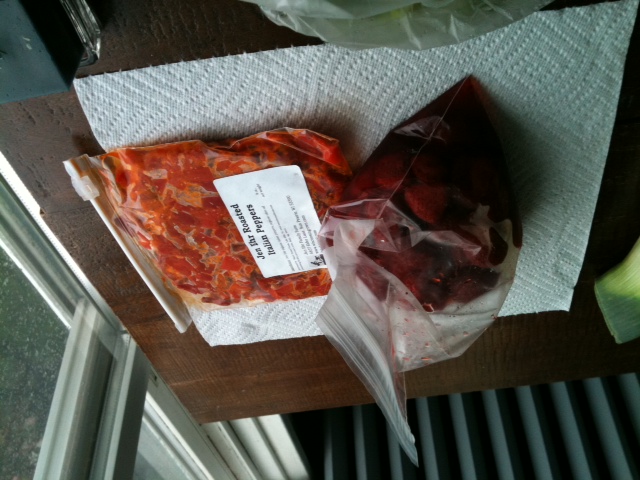
Frozen strawberries and roasted red peppers.

I didn’t start cooking until Saturday morning, when Mary and I experimented with an egg dish:

Baked Omelet filled with vegetables

Easy Baked Omelet

  • 5 eggs
  • 1/4 cup milk
  • 1/3 cup flavorful grated cheese (we used Feddoste)
  • 1 bunch arugula, rinsed, thoroughly dried and roughly chopped
  • 1/2 cup mushrooms, sliced
  • 1 small leek, cut in half length -wise, then chopped. Rinsed.
  • 1 1/2 tablespoons chopped roasted red peppers
  • 1 scant tablespoon butter
  • splash of olive oil
  • salt and pepper to taste
Whisk eggs and milk together. Heat butter and olive oil in a pan over medium. Add mushrooms and leeks and cook until just soft. Add arugula and stir in until barely wilted. Turn off heat and stir in red peppers. Pour vegetables into 1 qt. casserole dish and add egg mixture, salt, pepper and half the cheese, stirring to mix. Top with remaining cheese. Bake at 350° F for 20 minutes, or until the omelet is puffed and golden brown on top. Serves four.
Wish me luck as I try to work through the rest!


The New Homemade•Handmade

A few weeks ago, I promised some upcoming changes—and as you can see from the new design, we’re ready to go!

The biggest change is the “we.” Lesley’s still here, but this week we’ll be introducing a new blogger, Mary. The two of us will be blogging together going forward, with most post being updates to each other on our latest projects. We’re both really excited and hope you enjoy the new format as much as we do already.

We both like to bake, decorate our places, do our own art and redo furniture. Lesley still does vegetarian cooking and jewelry making, but Mary cooks a little, bakes a lot and loves to throw parties (with themes and activites). She also makes her own cards and does other paper crafts, so there’s plenty of new topics for us to explore.

If you’re interested in learning more about us, check out the tab at the top of the page.


Exciting news!

I know this blog has been a bit neglected this year, but there are some exciting changes coming that will hopefully turn things around. The format will be changing, and there will be some visual and layout changes coming too.

So, if you’re still reading, please stay tuned. I think you’ll enjoy what’s coming up.

Gingerbread Waffles

I have to admit, I don’t think I ever would have dreamed up gingerbread waffles on my own. This morning I was looking for something warm and homey for breakfast and I turned to The New Settlement Cookbook* for a basic waffle recipe. As I scanned the basic recipes, I came across “Gingerbread Waffles” and just had to give it a try. Warm, spicy-sweet and perfect for a winter morning. Not only did they taste great (I ate them as the book recommended, with a little bit of butter and sprinkling of powdered sugar), but the texture was perfect—crispy on the outside and fluffy on the inside. These would be excellent with a jam or fresh fruit.

Gingerbread Waffles

Gingerbread Waffles (adapted from The New Settlement Cookbook, 1991 edition)

3 eggs
1/4 cup sugar
1/2 cup molasses
1 cup buttermilk (I used sour milk)
1 1/2 cups flour
1 tsp ground ginger
1/2 tsp ground cinnamon
1/2 tsp ground cloves
1/2 tsp salt
1 tsp baking soda
1 tsp baking powder
1/3 cup butter, melted

1. Using a whisk in a deep bowl, beat the eggs until light and frothy. Add the sugar, molasses and milk, whisking thoroughly after each edition.

2. In a separate bowl, sift together all the remaining dry ingredients (everything except the butter). Whisk the dry ingredients into the wet (a little at a time will help avoid flour clumps), and then add the melted butter and whisk until blended.

3. Warm up your waffle iron for about 5 minutes, then add your batter to the middle of each grid. (These waffles fluffed up quite a bit so I had a lot of batter dripping out of my first batch—start light and add more batter next time if needed). Cook until the surface is slightly darker and a light crust has formed (about 6 minuted on my iron).

4. Serve immediately, with butter and powdered sugar, or the topping of your choice.

Yield: About 16 waffles, depending on the size of your iron.

I could have fed 4-5 hungry people with this batch. I froze my leftovers to toast up later.

* A note about my source: The New Settlement Cookbook is a newer edition of a great traditional cookbook that was born right here in Milwaukee. It’s filled with updates of traditional ethnic recipes and basics. While it doesn’t have the beautiful photos and modern flair of more contemporary cookbooks, I find myself turning to this book again and again for the basics, especially for baked goods. Sadly, it’s out of print, but worth picking up at a second hand bookstore if you ever come across it. (My mother found copies for my sister and I after thwarting our multiple attempts to steal hers.)

Breakfast Berry Crumble

Why aren’t crumbles and crisps served for breakfast more often? They are a great warm way to start off the day.

This morning I was trying to figure out something warm to have for breakfast, since my apartment was freezing. No eggs, no oatmeal, but I did have berries, plums and yogurt.

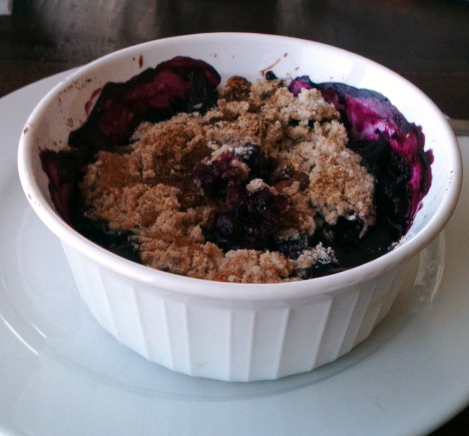
This simple crumble was very easy to make with just a few things I had on hand, and was the perfect size for popping in the toaster oven. Served with a dollop of vanilla greek yogurt on top, it was an excellent start to my morning.

Blueberries, plums and a simple struesel topping make an easy warm breakfast.

Breakfast Berry Crumble

  • 1 cup blueberries
  • 1 plum, diced
  • 1 tablespoon honey
  • 1 tablespoon sugar
  • 2 tablespoons flour (I used whole wheat)
  • 1 tablespoon butter
  • 1/2 teaspoon cinnamon
  • vanilla greek yogurt, for serving
Mix the blueberries, plum pieces and honey together in an ovenproof ramekin. Drizzle with honey and mix. In a small bowl, use a fork to combine the remaining ingredients until the mixture is fairly uniform and resembles a coarse meal. sprinkle on top of the berr-plum mixture. Bake at  375° for about 15 minutes (until the mixture is bubbling and the topping is slightly golden and collapsed. Serve with vanilla yogurt on top.

Talking about beads

This last week has been crazy-busy as I’ve been preparing to give a presentation to the Bead Society of Greater Chicago. I drove down last night after work and spent some time with their beaders talking about design and how really knowing the basics allows you to be more creative and get better finished pieces.

I had a hard time narrowing down one topic to talk about. Originally, I was going to go “three miles wide and an inch deep” and go through 50 tips for better beading. But the more I worked on the presentation, the more I realized that everything was leading back to the basic premise that to create your best work you need to know the basics. Not just basic design concepts, like line, shape and movement, but the basics of your tools, materials and techniques and actually consciously choose how you’re using all these elements.

Of course, in the end, I ended up talking about publishing designs, working on a magazine, and copyright. Maybe next time I’ll plan to start there!

That old saying about absence is true, right?

Sadly, I’ve been one of those neglectful bloggers lately. As a reader, those bloggers make me crazy. They string me along, make me eager for their content, and then they just disappear. Not that I think I have readers eager for my content. Well, maybe one (Hi, Susan!). Of course, now I completely understand. Real life gets in the way. People move, they have babies, they launch new business ventures, they are busy with actual paying work. They have family and friends that want to spend time with them. They’re immersing themselves in their novels.

I have goals I want to meet too, but I don’t want to be that type of blogger, so here’s my self-issued challenge. I will post, either here or on LesleyMWeiss.com, at least two posts a week in the month of February. And, aside from this one, there will be no cross-overs. So, if your reading this, I hope you’ll come along and see where this month takes me.

Just because I haven’t been blogging doesn’t mean I haven’t been hard at work. I’ve been working on a new book proposal, and I’m excited to give a presentation at the Bead Society of Greater Chicago next week. I’ll be showing a little of what I’ve been working on over the next month.

To cut, or not to cut…

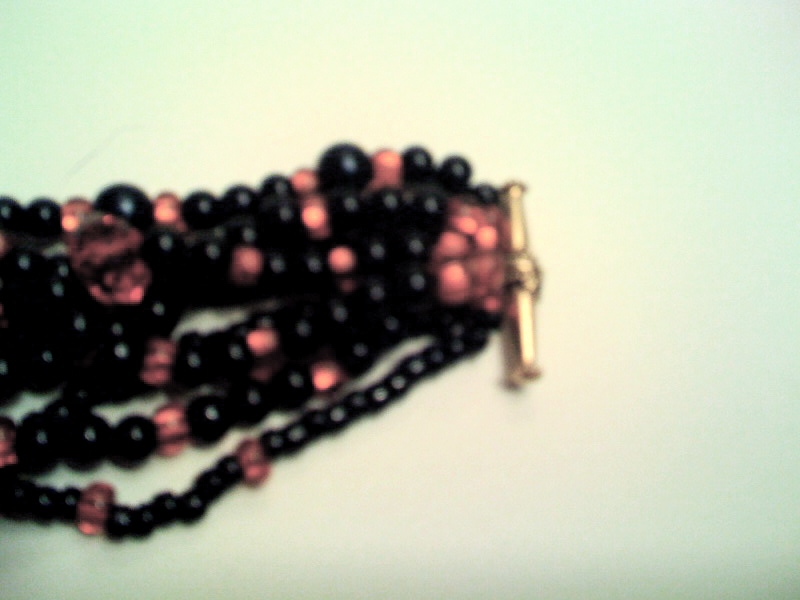
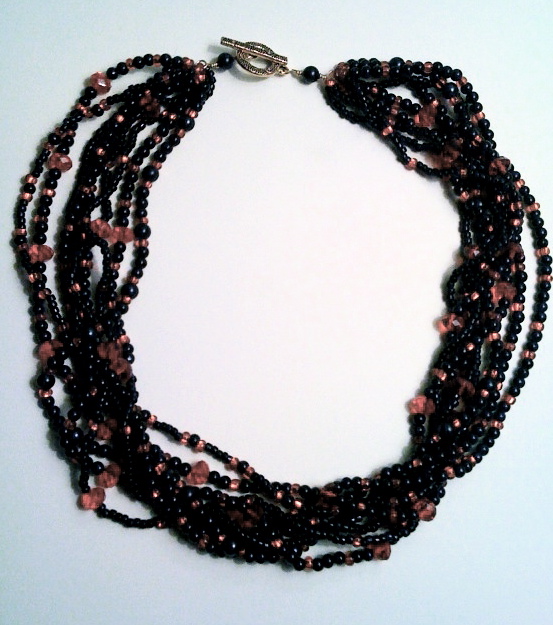
In my last post, I mentioned adding a few beads at each end of the strand to make the necklace easier to clasp. Then, I went on to make another necklace and promptly forgot that rather elementary beading rule. The result:

(I know, I know, the photo is terrible. I’m without a digital camera at the moment, so a blurry iPhone pic is all I have to work with.)

Do you see the problem? There’s not enough room for the toggle bar to swivel and fit through the clasp loop. I even tried stretching the strands to increase the length, but as I used DandyLine, that didn’t help at all.

I had to make a choice: Cut the thread, or cut the clasp. Yep, I said cut the clasp.

This is a nine strand necklace, and it took me about 5 hours to string (if not a little longer). Restringing it would be a little faster, because the pattern is already set, but the holes on some of the round beads are really small (so I couldn’t just run a needle up the strands). It would probably take me about 2 1/2 hours to restring.

Cutting the clasp would mean I’d be out a clasp, and, if I couldn’t slide the thread loops on another clasp loop or wire, I’d have to restring anyway. Now, if this was an expensive clasp, I wouldn’t even consider it. But this was a $2.00 base metal clasp* I got on clearance, so I didn’t think it was a big deal to wreck it.

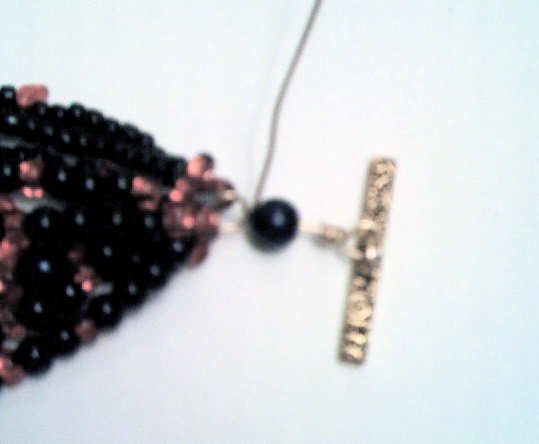
I went with option 2. First, I cut a piece of wire, and attached it to the loop on a new clasp with a wrapped loop. I slid a matching bead on the wire and made the first half of a wrapped loop. Then, I slid the end of the wire through the first loop of thread on the necklace. I very carefully clipped the clasp loop on the old clasp, and one by one slipped the thread loops off the old clasp and onto the wire. Then I finished with a wrapped loop.†

I did the same thing on the other side. I think the end result turned out very nice, and it’s actually possible to close the clasp, which is a nice feature in jewelry, don’t you think?

* I’m usually an advocate for high-quality materials (they look better and last a lot longer!), but this necklace was made entirely out of demonstration leftovers and bargain bin glass. I don’t spend a lot on demo materials, since I give them away. Since the clasp and black rounds were purchased for demonstrations, and the wire was leftover from another project, the only materials I bought for this project were the faceted rondelles ($1 a strand) and two tubes of seed beads ($6). I pretty sure that if there’s a time to use a base metal clasp, this is it.

† Anytime you are combining thread and wire remember to use a soldered or wrapped loop. Even if you’re an expert at closing jump rings, thread can slip right between the wire ends.

Black and white gemstone necklace

Remember these?

I purchased these strands at the Bead&Button Show a few months ago, and I actually have a finished piece to show for it.

My sister is heading off on a vacation to Napa this evening (her first real vacation as an adult, lucky girl), and I made her a necklace to go with one of the summery dresses she packed. Did I go with beachy peach and green? Sea colored blue? Nope. I chose the black-latticed white agate beads to go with a stark white sundress she was taking along. Then I separated the beads with tiny faceted glass rondelles in an opal-like white. I added a few smaller beads to each end of the strand to make it a little easier to clasp, and voilà:

Two things I like about this project: 1) It was very easy. I strung the entire piece and attached the clasp in about an hour. 2) The strand of gemstones was too short to make a necklace on its own, but adding the rondelle spacers not only increases the length, it enhances the colors, distributes the weight of the necklace more evenly, and helps it curve more smoothly. All good things.

Have you made any unexpectedly simple projects lately? Isn’t it great how something so easy can be such a great impact piece?