Cooking from a CSA, Part 5: Three-Greens Pasta

My favorite meal this week was born of necessity. I was one day away from the next CSA delivery and had a pile of vegetables left to use. One of the easiest ways to reduce a mass of greens is to cook it, so I cleaned three bunches of greens, added some turnips and veggie sausage, and tossed it with some pasta. Quick, easy, and really delicious. The variety of greens adds a lot of subtle flavor, and the veggies sausage (Yves Italian variety, I believe) added some nice spice.

Three-Greens Pasta

  • 1 lb pasta
  • 1 bunch spinach (washed, stems removed, sliced in 1-in. ribbons)
  • 1 bunch arugula (washed, stems removed, sliced in 1-in. ribbons)
  • 1 bunch Swiss chard (washed, stems removed, sliced in 1-in. ribbons)
  • 1 bunch turnips, scrubbed and cut into quarters
  • 2 links vegetarian sausage, sliced
  • 1 tbl. minced garlic
  • olive oil
  • salt, pepper, oregano, thyme (to taste)
  1. Put a large pot of water on to boil for the pasta. Cook the pasta as directed, but add the spinach and arugula for the last 2 minutes of cooking. Just pile it right on top of the pasta and water, and swirl it with a spoon. Then, drain the contents of the pot in a colander and put in a large serving bowl.
  2. While the pasta is cooking, heat olive oil in a large skillet on medium-high heat. Add the veggie sausage and turnips, and sauté for about five minutes, until contents start to lightly brown.
  3. Add chard, garlic and seasoning to the pan, and stir. Cook about 5 minutes, until chard is slightly wilted but still has some body. Remove from heat.
  4. Add sautéed ingredients to the pasta mixture, and stir. Serve immediately.

Cooking from a CSA, Part 3: Week 2 and Spring-time Saute

My second CSA box arrived with all kids of goodies:

Black Spanish and traditional red radishes

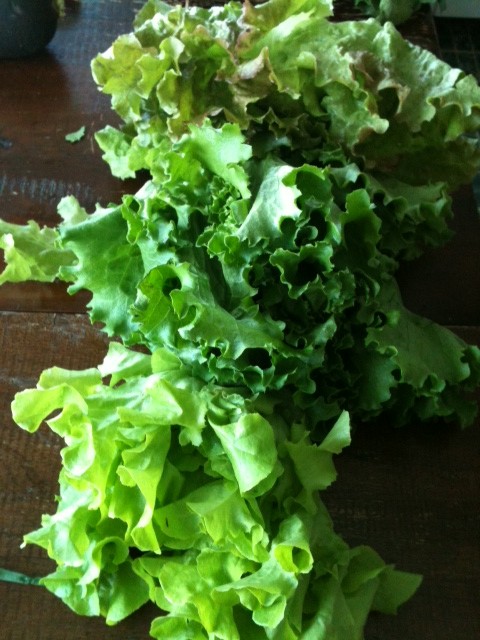
Three kinds of lettuce

Three kinds of beets

Aspargus

Leeks, green garlic, and scallions

I also received a bag of tomato puree and a 5 lb. bag of golden potatoes. Most of the this week’s goodies went into salads, and I made another pasta dish similar to last week’s, but with asparagus and leeks–oh, and I threw in pine nuts and a can of chopped clams–so good!

But my favorite thing this week turned out to be these:

Haruki Turnips

I’ve never been a fan of turnips, but when I got this adorable bunch of baby turnips, or haruki turnips as they are usually known, In my CSA box, I had to give them another try.

I started by turning to the Internet for help and found a few recipes for pasta with turnips and this recipe for gnocchi with turnips that served as my inspiration. (That gnocchi looks excellent and I have to go back and try making that sometime).

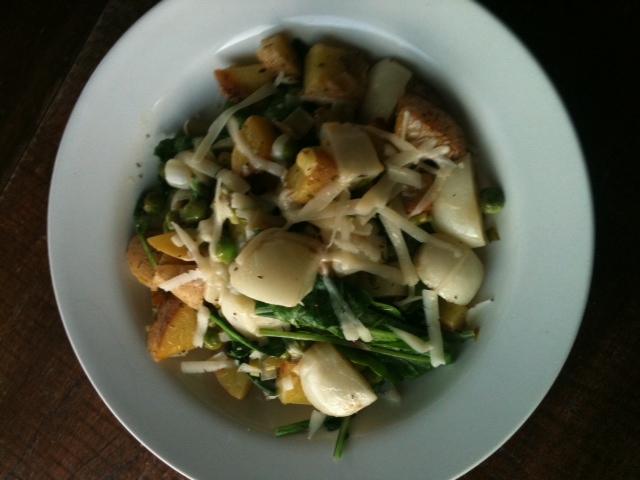
Using only what I had on hand from my latest CSA box, I whipped up a quick buttery sauté that totally turned me around on turnips! I hope I get another bunch in the box soon.

Springtime Sauté with Turnips and Potatoes

  • 2 small to medium potatoes
  • 1 bunch baby turnips, including greens
  • 1 small leek
  • 2 green garlic stalks
  • oregano
  • thyme
  • salt and pepper
  • 1 tablespoon olive oil
  • 1 tablespoon butter
  • Parmesan (optional)

1. First, wash all the vegetables, taking extra care to scrub the potatoes with a brush. Dice the potatoes (skin on), and slice the leek and green garlic into thin rings. Throw the rings in a colander and give them a good wash. Remove the greens from the turnips and cut the turnips into quarters. Remove the long stems from the greens and cut the leaves into 1-in. wide strips.

2. Heat the olive oil and butter on the stove on medium-high heat, until the butter is melted. Add the potatoes and cook, stirring occasionally, until just starting to brown–about 5 minutes. Throw in the leeks and green garlic and cook about 2 min., until they just start to loosen up. Add a sprinkling of oregano, thyme, salt and pepper.

3. Add the turnips and cook about 5 minutes, stirring frequently.

4. Add the turnip greens and cook until just wilted.

Voilá. Serve in a bowl and top with grated cheese if desired.

Cooking from a CSA, Part 2: Week 1 Wrap-Up

My first week with the CSA was pretty much as success, except for one thing: Many of the greens wilted before I had a chance to eat them. Luckily, the CSA-blogging community (who knew such a wondrous resource existed?) came to my rescue and suggested that I bag the next batch to keep moisture in. There is a great CSA link party every week, hosted by In Her Chucks, which you can find here. It’s a great way to find other people writing about CSAs.

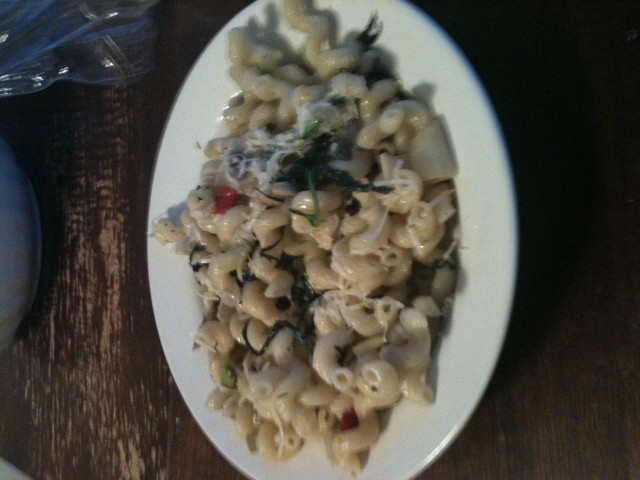
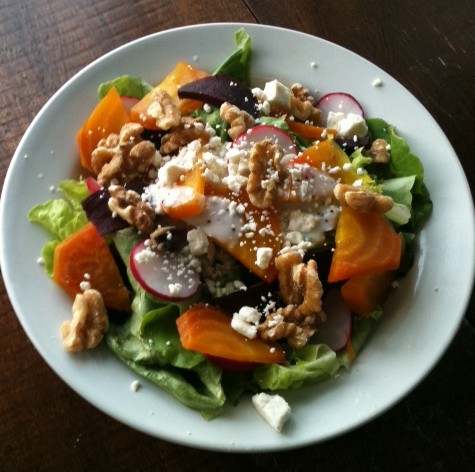
I made a number of  salads and sandwiches, but my two favorite dishes from the week were a great pasta with leeks, green garlic, red peppers, mustard greens, and mushrooms (I bought the mushrooms, but every thing else came from the box), and a beautiful salad with two types of beets (roasted in the oven at 300 for a few hours, then left in the fridge overnight to cool), lettuce, radishes, scallions, walnuts, and feta.

Delicious Sweet-or-Savory Scones

My first CSA box had a bag of frozen strawberries that had already thawed by the time I got home. I had to use those strawberries fast. Since thawed strawberries naturally seep out a lot of juice, they were perfect for a sauce, but (for once) I wasn’t in the mood for cake. This last weekend was chilly, dark, and rainy, so I wanted a warm treat for breakfast–and I had a guest to serve. So Mary and I made scones.

I made a rather basic scone recipe from Nigella Lawson. So basic, in fact, that it has no sugar! Fresh out of the oven, the scones were fantastic—light, airy and delicious. Crumbly, like a good scone should be. We halved them and spooned some strawberries and juice onto the bottom half. A little whipped cream and it would have been an excellent version of strawberry shortcake—as it was, it was exactly the warm treat I was looking for.

I had leftover scones for the next few days. The problem with scones is that after the first few hours, they become a little soft or soggy feeling. My solution to this was to pop them in the toaster over at 350° for a few minutes. The tops darkened slightly, but they were the perfect texture once again.
I also tried them with a savory topping with a dinner salad. I took the warm-from-the-toaster-oven scone, cut it in half, and added a slice of cheese and some roasted red peppers to the middle. It was just as good as the sweet version—the scone can be a great substitute for biscuits.
Sweet-or-Savory Scones
Adapted from “Lily’s Scones” in Nigella Lawson’s How to Be a Domestic Goddess*
  • 3 1/3 cups flour
  • 1 teaspoon salt
  • 4 1/2 teaspoons cream of tartar
  • 1/4 cup cold butter, cut in small pieces
  • 2 tablespoons shortening, in small lumps
  • 1 1/3 cups milk
  • 1 large egg, beaten
Preheat the oven to 425°F. Shift dry ingredients together. Use a pastry blender to blend in butter and shortening until the mixture is even and crumbly. Add all the milk, and mix until just blended. Lay on floured surface and knead briefly–it will seem like a sticky mess.
The original recipe call for rolling out the dough and using a round cutter. I simply rolled it to a 1 in. thick rectangle and cut it into 12 equally-sized pieces.
Place scones on baking sheet–they can be close together–and bake for 20 minutes, until lightly golden on top. Serve warm or reheated.
* Nigella Lawson’s How to be a Domestic Goddess is one of my all-time favorite cookbooks! So many good recipes, with a focus on baked goods and other comfort foods. And her language is casual and food-passionate. She’s English, so I’ll admit there’s a recipe or two that I haven’t loved, but there’s at least a half dozen recipes in each of her books (and I own several) that’s in permanent rotation in my family.

Cooking from a CSA box, Part 1: Joining a CSA

A few months ago, I took a leap of faith and signed up for a CSA (that’s Community Sponsored Agriculture) option that was delivering to my office. Every week from late April to mid-November a bushel of vegetables will be dropped off at our headquarters cafeteria, filled to the brim with fresh-off-the-farm organic vegetables.
Why was it a leap of faith? After all, fresh organic vegetables are awesome, aren’t they?

I’ve looked into CSAs a few times and decided not to sign up for a few reasons:

1) A bushel of vegetables a week is a lot of vegetables! I hate wasting food, and I worry about my refrigerator being filled with rotten produce.
2) Members don’t have any say in what arrives in their box. So if it’s 3 lbs. of turnips or another vegetable I’m not too fond of, I’m out of luck.
3) Some of them are quite pricey, and don’t work with my food budget.
4) Trying to remember to drive over to the drop-off location, and arranging my schedule to make that happen seems very inconvenient.

The CSA offered through my office eliminated a few of my worries:

1) Since I’m a vegetarian (well, pescetarian, if you want to be technical), I eat a lot of produce anyway, so this wasn’t my strongest concern. A rep from the farm came to the office and answered a lot of my questions, including the one about the amount of food. They also offered a half-share with biweekly pick-up for the summer portion of the CSA (June through October).
2) I like trying new things, especially with food. Maybe I can learn to love turnips.
3) With the half-share and a monthly payment of $75 spread over the entire year, my concerns about the price were alleviated. Since I originally researched CSAs a few years ago, the cost of groceries has gone way up. Also, the grocery store nearest my home has TERRIBLE produce. So I often find myself running to the local organic co-op last minute, and that type of grocery shopping gets quite pricey. $75 a month for the bulk of my food will cut my grocery bill by quite a bit.
4) They deliver to my office. It can’t get easier than that–I’m there anyway!

So I’m very excited to have inexpensive fresh produce coming to me at work.

I received the first box on Thursday, and I’ll admit that I was a little overwhelmed. Look at everything inside:

Left to right, top to bottom: Mustard greens, radishes, scallions, green garlic, leeks, frozen strawberries, three types of beets, a bag of mixed salad greens, celeriac, more beets, a head of parnisse, arugula, mizuna, purple mustard greens.

Plus, there were two bonuses:

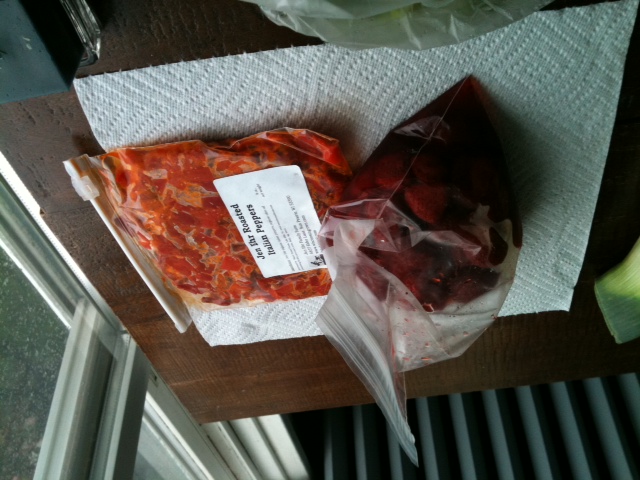
Frozen strawberries and roasted red peppers.

I didn’t start cooking until Saturday morning, when Mary and I experimented with an egg dish:

Baked Omelet filled with vegetables

Easy Baked Omelet

  • 5 eggs
  • 1/4 cup milk
  • 1/3 cup flavorful grated cheese (we used Feddoste)
  • 1 bunch arugula, rinsed, thoroughly dried and roughly chopped
  • 1/2 cup mushrooms, sliced
  • 1 small leek, cut in half length -wise, then chopped. Rinsed.
  • 1 1/2 tablespoons chopped roasted red peppers
  • 1 scant tablespoon butter
  • splash of olive oil
  • salt and pepper to taste
Whisk eggs and milk together. Heat butter and olive oil in a pan over medium. Add mushrooms and leeks and cook until just soft. Add arugula and stir in until barely wilted. Turn off heat and stir in red peppers. Pour vegetables into 1 qt. casserole dish and add egg mixture, salt, pepper and half the cheese, stirring to mix. Top with remaining cheese. Bake at 350° F for 20 minutes, or until the omelet is puffed and golden brown on top. Serves four.
Wish me luck as I try to work through the rest!

Gingerbread Waffles

I have to admit, I don’t think I ever would have dreamed up gingerbread waffles on my own. This morning I was looking for something warm and homey for breakfast and I turned to The New Settlement Cookbook* for a basic waffle recipe. As I scanned the basic recipes, I came across “Gingerbread Waffles” and just had to give it a try. Warm, spicy-sweet and perfect for a winter morning. Not only did they taste great (I ate them as the book recommended, with a little bit of butter and sprinkling of powdered sugar), but the texture was perfect—crispy on the outside and fluffy on the inside. These would be excellent with a jam or fresh fruit.

Gingerbread Waffles

Gingerbread Waffles (adapted from The New Settlement Cookbook, 1991 edition)

3 eggs
1/4 cup sugar
1/2 cup molasses
1 cup buttermilk (I used sour milk)
1 1/2 cups flour
1 tsp ground ginger
1/2 tsp ground cinnamon
1/2 tsp ground cloves
1/2 tsp salt
1 tsp baking soda
1 tsp baking powder
1/3 cup butter, melted

1. Using a whisk in a deep bowl, beat the eggs until light and frothy. Add the sugar, molasses and milk, whisking thoroughly after each edition.

2. In a separate bowl, sift together all the remaining dry ingredients (everything except the butter). Whisk the dry ingredients into the wet (a little at a time will help avoid flour clumps), and then add the melted butter and whisk until blended.

3. Warm up your waffle iron for about 5 minutes, then add your batter to the middle of each grid. (These waffles fluffed up quite a bit so I had a lot of batter dripping out of my first batch—start light and add more batter next time if needed). Cook until the surface is slightly darker and a light crust has formed (about 6 minuted on my iron).

4. Serve immediately, with butter and powdered sugar, or the topping of your choice.

Yield: About 16 waffles, depending on the size of your iron.

I could have fed 4-5 hungry people with this batch. I froze my leftovers to toast up later.

* A note about my source: The New Settlement Cookbook is a newer edition of a great traditional cookbook that was born right here in Milwaukee. It’s filled with updates of traditional ethnic recipes and basics. While it doesn’t have the beautiful photos and modern flair of more contemporary cookbooks, I find myself turning to this book again and again for the basics, especially for baked goods. Sadly, it’s out of print, but worth picking up at a second hand bookstore if you ever come across it. (My mother found copies for my sister and I after thwarting our multiple attempts to steal hers.)

Breakfast Berry Crumble

Why aren’t crumbles and crisps served for breakfast more often? They are a great warm way to start off the day.

This morning I was trying to figure out something warm to have for breakfast, since my apartment was freezing. No eggs, no oatmeal, but I did have berries, plums and yogurt.

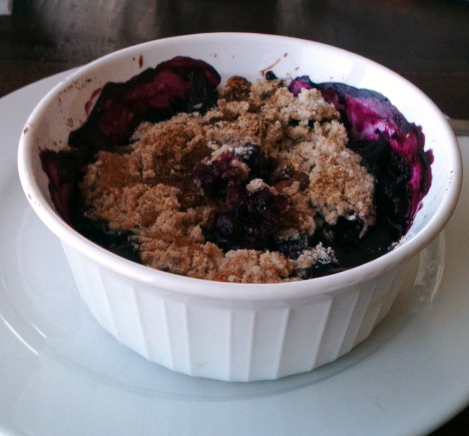
This simple crumble was very easy to make with just a few things I had on hand, and was the perfect size for popping in the toaster oven. Served with a dollop of vanilla greek yogurt on top, it was an excellent start to my morning.

Blueberries, plums and a simple struesel topping make an easy warm breakfast.

Breakfast Berry Crumble

  • 1 cup blueberries
  • 1 plum, diced
  • 1 tablespoon honey
  • 1 tablespoon sugar
  • 2 tablespoons flour (I used whole wheat)
  • 1 tablespoon butter
  • 1/2 teaspoon cinnamon
  • vanilla greek yogurt, for serving
Mix the blueberries, plum pieces and honey together in an ovenproof ramekin. Drizzle with honey and mix. In a small bowl, use a fork to combine the remaining ingredients until the mixture is fairly uniform and resembles a coarse meal. sprinkle on top of the berr-plum mixture. Bake at  375° for about 15 minutes (until the mixture is bubbling and the topping is slightly golden and collapsed. Serve with vanilla yogurt on top.

Website of the Week: Smitten Kitchen

Starting this week I’m including a new feature sharing best content I’m finding, starting with some of my daily must-reads.

This week’s site is one that you’ve probably already heard of if you like to cook: Smitten Kitchen. Deb Perelman’s cooking blog takes you right into her tiny New York City kitchen through stunningly good food photography, great descriptions, clear instructions, and a lot of personality and advice.

Three things I love about this site:

1. The mixture of original recipes and recipes from other sources. Deb’s working on a cookbook of her own creations (that I can’t wait to buy!) and she’s proven she’s a master at tweaking a recipe until it’s just right. But she also shares great recipes from other sources, such as magazines and cookbooks. This sharing has turned me on to a number of other great cooks and cookbooks, including Sky High (which I fell in love with after making the Chocolate Peanut Butter Cake) and Ottolenghi (whom I was introduced due via the Cauliflower and Parmesan Cake).

2. The way Deb describes food. To me, great food writing is not just instructions or descriptions of how something looks or tastes. It’s about the way strawberries mean summer or a certain babka reminds you of home. Cooking, for many of us, is a way to show the people we care about that we want to do something for them: make them the perfect birthday cake, remind them of a great vacation, warm them up on a cold winter night…those feelings are evident in Deb’s writing.

3. The instructions. I used to write instructions for a living, and I know it can be hard. These are good, clear instructions. The best part is that Deb often includes not only what to do, but why you do it and what happens if you don’t (for example, I made the Chocolate Peanut Butter cake last night, and the recipe advised me to freeze the cakes before frosting them to keep them from falling apart). She offers shortcuts and substitutions, which is really helpful when something specific is called for in the recipe and you don’t have that exact spice or type of pan on hand.

If you are looking for a great collection of tested recipes with beautiful photos, clear instructions, and an easy-to-search index, this site is it.

Blueberry-lemon muffins with ginger streusel topping

The morning Mom and I went to the estate sale at the Shorecrest we stopped for coffee and breakfast and I had a fabulous blueberry muffin. It was just about perfect—not too dense, not too cake-like—and it had a very subtle flavor beyond the blueberry. I thought it was ginger, but Mom thought it was lemon. Well, of course, I had to try to recreate it on my own.

I’ll admit, this has actually taken a few tries. The first batch was much too lemony, and I used fresh ginger instead of ground. They were too moist, and the flavor was just…off. Not bad (they were edible), but nothing I’d like to share.

The new batch, however, with the streusel topping, is good. Possibly the best muffins I’ve ever made. And I have made a lot of muffins.

The base for this recipe comes from one of my standby cookbooks, The Good Housekeeping Illustrated Cookbook. My mom got one for her wedding shower…I had to hunt for mine at Goodwill. I’ve changed the proportions slightly, added lemon and spices and the streusel topping, and substituted a little whole wheat flour for the white (whole wheat flour keeps the muffins from getting too light and cupcake-like, in my opinion).  You could use all-purpose flour only and eliminate the spices and lemon and you’d still have a pretty good blueberry muffin.

Blueberry-lemon muffins with ginger streusel topping

Makes 12 muffins

Ingredients
  • 1 3/4 cups all-purpose flour
  • 1/2 cup whole wheat flour
  • 6+ tablespoons sugar
  • 1 heaping tablespoon baking powder
  • 1/2 teaspoon salt
  • 1/2 teaspoon nutmeg
  • 1/2 teaspoon cardamom
  • 1 teaspoon ginger
  • 3 tablespoons lemon juice, or zest and juice of one small lemon
  • 1 scant cup fresh or frozen blueberries
  • 1 egg
  • 1 cup milk
  • 1/4 cup canola or vegetable oil
  • 2+ tablespoons butter

Directions

1. Prepare your muffin cups (I prefer individual silicon cups for muffins) by lining or buttering as necessary, and preheat the oven to 400° F.

2. In a small bowel, gently mix the whole wheat flour and blueberries until the blueberries are coated. (Supposedly this prevents the berries from sinking.)

3. In a large bowel, mix 1 1/2 cups all purpose flour; 4 tablespoons sugar; 1/2 teaspoon each of salt, nutmeg, cardamom, and ginger; and1 heaping tablespoon of baking powder. (Note: The remaining flour, sugar, and ginger is for the topping.)

4. In a separate bowl, beat the egg and mix with 1 cup milk and 1/4 cup oil.

5. Add the liquid to the flour mixture, and stir until barely mixed. Add the blueberry mixture and the lemon juice (and zest, if using). Stir just until the flour is mixed in—the batter should still be slightly lumpy (Overmixing muffins toughens them).

6. Spoon the batter into the muffin cups. For regular muffins they’ll be a bit over 3/4 full.

7. In a small bowel, mix a scant 1/4 cup flour, 2 tablespoons butter, 2 tablespoons sugar, and 1/4 teaspoon ginger with a fork until you have uniformly crumbly mixture. If necessary, add a little more butter or sugar to get the right texture. (This does make a little more topping then necessary.)

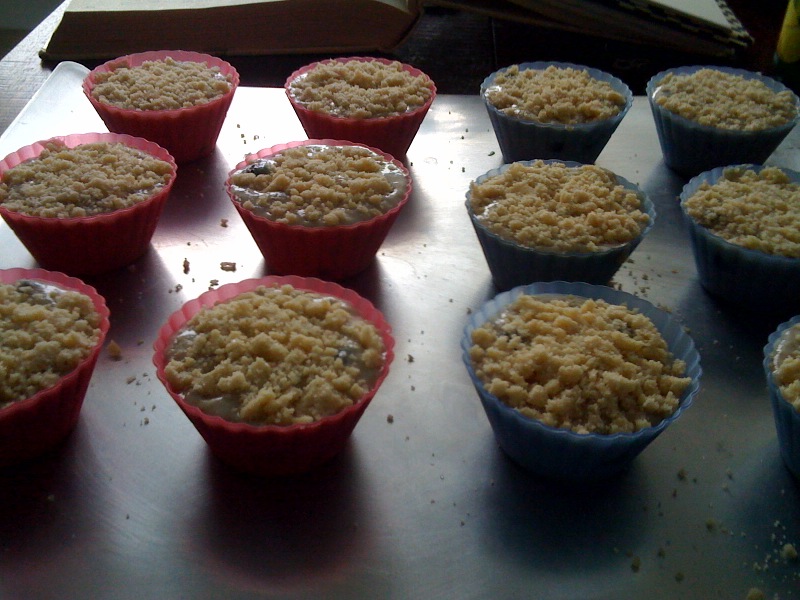
8. Sprinkle the topping evenly over all the muffins. I like to use the fork to lightly tap the topping into the batter (it keeps it from rolling right off when you eat the muffin).

9. Bake at 400 for about 20 minutes, or until lightly golden and a toothpick test comes out clean. Let cool on a wire rack.
Enjoy!