Bead&Button Show, here I come!

Now, you may have noticed a gap between my first two entries on this blog. “Why would Lesley create a blog and then abandon it so fast?” you may have wondered. Let’s just say May was a very fun and busy month, and I’ve been buried in beads for the last two weeks.
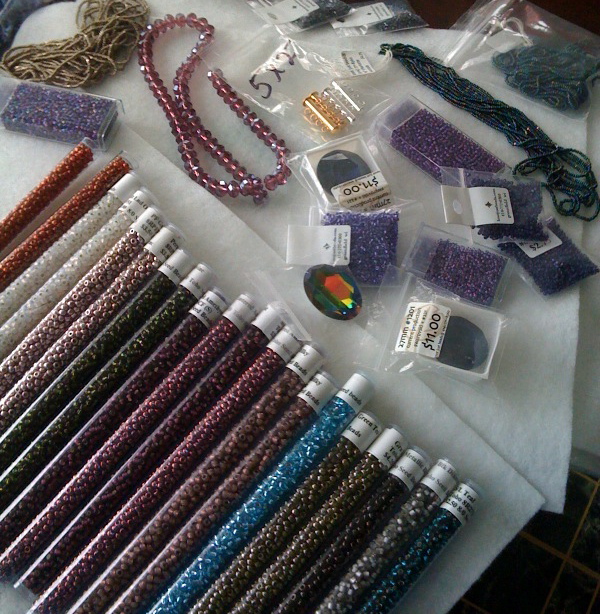
It’s almost show time (Bead&Button Show time, that is), and I’m teaching two classes this year, both based on projects from my book. I’m very excited to be part of the show as a faculty member this year (I’ve been staff at the show a few times too), but pulling together the kits has been a little difficult. It’s a challenge to pick colors for other people, even if you’ve heard their preferences ahead of time.

I’ve been lucky enough to get some advice from show veterans, but their advice is sometimes hard to apply. My friend Anna, who’s taught for years and sells instructions and kits independently, says that it’s a good idea to make a few extra. But she’s been at the show long enough that she’s a very popular teacher, and she’s had classes sell out. My classes were no where near selling out. So pulling together kits in a situation where I can’t buy bulk, want my students to have nice materials, and don’t want to go over the kit fee is going to be a challenge. I’m a little worried that I won’t be prepared for extra students who sign up at the last minute so I’ve made quite a few extra kits. The only question left is–what do I do with them if I have extras (and I will probably have extras)? I can’t afford to swallow the extra kit costs.

As far as colors, fellow beader and teacher Maggie advised me that there are two ways to do kit colors. You can either say you are a color expert and getting your colors is part of the class, or you can let the students pick the kits themselves when they arrive. She warned me that the more students you have in your class, the more likely someone will be unhappy and with the second choice there might be chaos. So I’ve assembled kits in colorways that I like (taking any student input I’ve received into account), but if I have leftover kits I might let students trade.

Show week is always crazy–lots of people to talk to and places to be. I’m excited to be taking on a new role this year, but I’m also glad I get to reinforce some of the relationships I’ve already built–talk to designers and authors I worked with, former coworkers, etc.

It should be a great week!

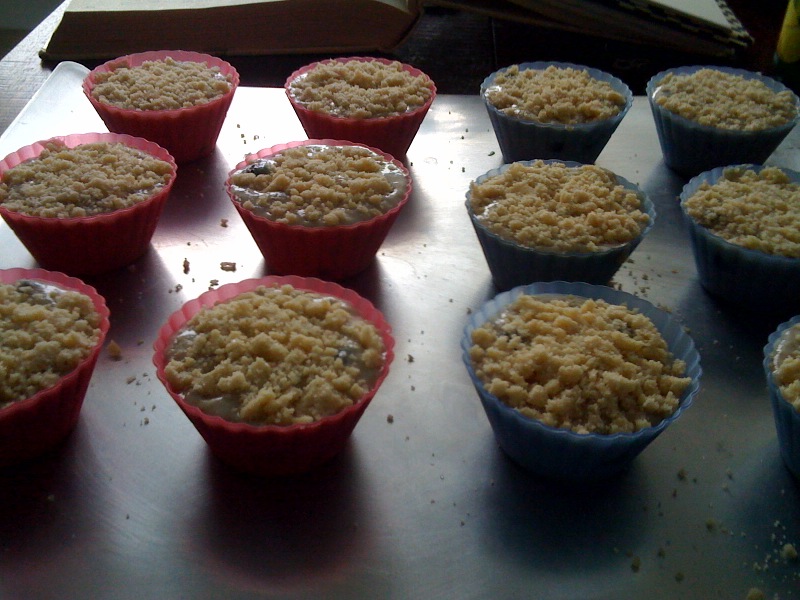
Blueberry-lemon muffins with ginger streusel topping

The morning Mom and I went to the estate sale at the Shorecrest we stopped for coffee and breakfast and I had a fabulous blueberry muffin. It was just about perfect—not too dense, not too cake-like—and it had a very subtle flavor beyond the blueberry. I thought it was ginger, but Mom thought it was lemon. Well, of course, I had to try to recreate it on my own.

I’ll admit, this has actually taken a few tries. The first batch was much too lemony, and I used fresh ginger instead of ground. They were too moist, and the flavor was just…off. Not bad (they were edible), but nothing I’d like to share.

The new batch, however, with the streusel topping, is good. Possibly the best muffins I’ve ever made. And I have made a lot of muffins.

The base for this recipe comes from one of my standby cookbooks, The Good Housekeeping Illustrated Cookbook. My mom got one for her wedding shower…I had to hunt for mine at Goodwill. I’ve changed the proportions slightly, added lemon and spices and the streusel topping, and substituted a little whole wheat flour for the white (whole wheat flour keeps the muffins from getting too light and cupcake-like, in my opinion).  You could use all-purpose flour only and eliminate the spices and lemon and you’d still have a pretty good blueberry muffin.

Blueberry-lemon muffins with ginger streusel topping

Makes 12 muffins

Ingredients
  • 1 3/4 cups all-purpose flour
  • 1/2 cup whole wheat flour
  • 6+ tablespoons sugar
  • 1 heaping tablespoon baking powder
  • 1/2 teaspoon salt
  • 1/2 teaspoon nutmeg
  • 1/2 teaspoon cardamom
  • 1 teaspoon ginger
  • 3 tablespoons lemon juice, or zest and juice of one small lemon
  • 1 scant cup fresh or frozen blueberries
  • 1 egg
  • 1 cup milk
  • 1/4 cup canola or vegetable oil
  • 2+ tablespoons butter

Directions

1. Prepare your muffin cups (I prefer individual silicon cups for muffins) by lining or buttering as necessary, and preheat the oven to 400° F.

2. In a small bowel, gently mix the whole wheat flour and blueberries until the blueberries are coated. (Supposedly this prevents the berries from sinking.)

3. In a large bowel, mix 1 1/2 cups all purpose flour; 4 tablespoons sugar; 1/2 teaspoon each of salt, nutmeg, cardamom, and ginger; and1 heaping tablespoon of baking powder. (Note: The remaining flour, sugar, and ginger is for the topping.)

4. In a separate bowl, beat the egg and mix with 1 cup milk and 1/4 cup oil.

5. Add the liquid to the flour mixture, and stir until barely mixed. Add the blueberry mixture and the lemon juice (and zest, if using). Stir just until the flour is mixed in—the batter should still be slightly lumpy (Overmixing muffins toughens them).

6. Spoon the batter into the muffin cups. For regular muffins they’ll be a bit over 3/4 full.

7. In a small bowel, mix a scant 1/4 cup flour, 2 tablespoons butter, 2 tablespoons sugar, and 1/4 teaspoon ginger with a fork until you have uniformly crumbly mixture. If necessary, add a little more butter or sugar to get the right texture. (This does make a little more topping then necessary.)

8. Sprinkle the topping evenly over all the muffins. I like to use the fork to lightly tap the topping into the batter (it keeps it from rolling right off when you eat the muffin).

9. Bake at 400 for about 20 minutes, or until lightly golden and a toothpick test comes out clean. Let cool on a wire rack.

Enjoy!

In which Lesley may have taken on more than she can handle

I’m usually a baker. Or a jewelry-maker. But on occasion, I’ll scoot over into the DIY arena. There’s not much for me to do there. I live in an apartment right now, and while there’s a lot I would love to do to the building (paint the back stairway, put in a humongous vegetable garden, learn to tuck-point), there’s not much to do to the apartment itself. I’ve painted, I’ve decorated, I’ve rearranged the furniture…I’m pretty much done.

But sometimes that doesn’t stop me from starting a do-it-yourself project for the home. Maybe I watch too much HGTV or read too many home-improvement blogs. Or it might be my mom’s influence.

In any case, Saturday morning found Mom and I standing in line outside the Shorecrest Hotel on Milwaukee’s East Side. The hotel’s been owned by the famous/infamous Balistreri family for decades and overlooks the lakefront from Prospect Avenue.  At one point in time it was one of the ritziest places in town, but it’s long since faded. There had been a death in the family a while back and they were holding an estate sale in the hotel.

When I lived on the East Side, Bronwen (the dog) and I would walk past the Shorecrest almost daily, and while I’ve eaten at the Savoy Room restaurant, I’ve never been inside the hotel itself. I’m a total sucker for old architecture, especially when it’s kind of hidden (one of my favorite memories from high school is when my AP Lit class got to tour the third floor of the school—like a time capsule in building form). So I really wanted to go to this estate sale—and I wasn’t the only one. We ended up waiting outside for almost an hour in the drizzle and cold. The only reason we got in that quickly was because so many people ahead of us in line gave up and left. It was pretty miserable out.

But we finally got in and rode the rickety old elevators up to the top floor. It’s in a sad state: What was once a bar and patio during the hotel’s heyday is now an attic-like storage area. There used to be mosaic floors and gorgeous arched windows and plaster hallways, but most of it’s been ripped out or stripped down over the years. The views in every direction are still stunning—most of the lakeshore and downtown could be seen. We weren’t allowed to take pictures, unfortunately.

By the time we got into the sale, most of the best stuff had been taken. There was an awesome collection of about twenty chairs with latticed wood sides and red upholstery that had sold to one of the first people through the doors. They needed quite a bit of work—all new fabric and paint or new wood stain, but the style was classic. Most of the leftovers were outdated and stained sofas, 1950s desks and Murphy beds. A few college students were there, grabbing up the sofas at better-than-Goodwill prices.

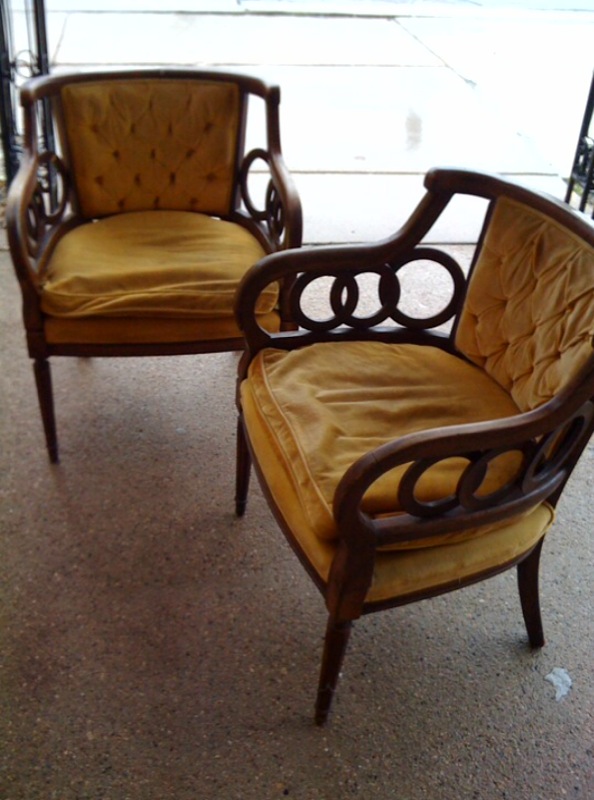
I did, however, find these chairs:

My new project chairs

They need a lot of work. I have no idea where they’ve been stored for the past few decades, but that upholstery is not coming in my apartment—yuck. But they are very sturdy, solid wood, and very comfortable to sit in. Picture them painted (I can’t restain them due to a huge gouge in the top of one that will need to be patched) and reupholstered (without the tufting). I think they’ll be the type of classic, solid chairs that people usually spill a few hundred bucks for.

This is by far the most ambitious refinishing project I’ve ever undertaken—These chairs have springs! And separate bases and cushions!—but I’m very excited. Right now they’re in my storage locker, waiting until I find the perfect fabric for them.

In the meantime, I’ll just have to find another project to keep me busy. I doubt it will be hard.